

Let’s talk about saving money.
I’m getting ready to take a long trip in about nine months that will take me into my next life adventure. More about that in a later post.
Today, I want to talk about one way you can save money right now, especially if you are a senior or disabled.
And this isn’t about clipping coupons or saving a few cents on gas.
This is something that can save you money while also giving you access to some of the most beautiful places in the country. Depending on which pass you qualify for, it may also save you quite a bit of money on camping and other recreation fees.
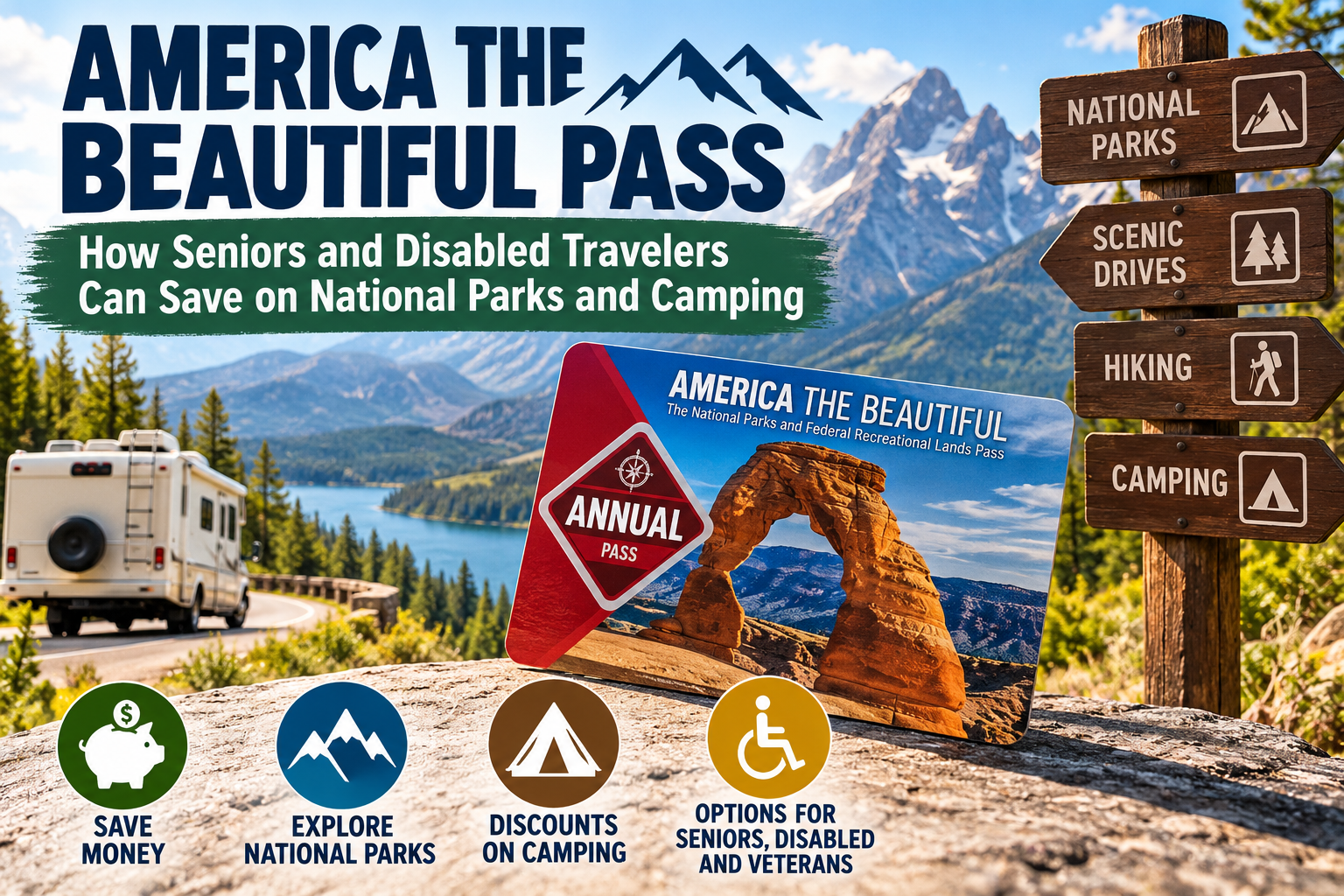
It’s called the America the Beautiful – National Parks and Federal Recreational Lands Pass.
Despite the name, this isn’t just a National Park Service pass. It is accepted at thousands of federal recreation sites managed by six federal agencies, including the National Park Service, U.S. Forest Service, Bureau of Land Management, U.S. Fish and Wildlife Service, Bureau of Reclamation, and U.S. Army Corps of Engineers.
If you spend much time traveling around the country, especially if you enjoy national parks and public lands, this little card can be worth having.
What does the pass cover?
At places that charge an entrance fee by vehicle, the America the Beautiful Pass generally covers the passholder and everyone traveling with them in one noncommercial vehicle.
If the site charges admission by the person instead, the pass generally covers the passholder plus three additional adults. Children under 16 are normally admitted free anyway.
That distinction is important because not every federal recreation area charges fees the same way.
It is also important to understand that the pass covers entrance fees and standard day-use amenity fees. It does not automatically mean that everything you do once you get inside a park is free.
I’ll come back to that in a minute.
There are several different passes
If you are a senior, the Senior Pass currently costs $20 per year, or you can pay $80 once for a lifetime Senior Pass.
To qualify, you must be a U.S. citizen or permanent resident and be at least 62 years old. You will need to show proof of your age and residency or citizenship.
Personally, if you know you’re going to continue traveling and visiting federal recreation areas, I think the $80 lifetime pass is one of the better deals out there.
There are also free Military Passes.
Current members of the U.S. military and their dependents can qualify for the free Military Annual Pass. Veterans and Gold Star Family members can qualify for a free Military Lifetime Pass.
One thing to keep in mind, however, is that the Military Pass does not come with the same expanded-amenity discounts that the Senior and Access passes sometimes provide. In other words, it can get you through the entrance gate, but it generally does not give you the Senior or Access Pass discount on camping.
Then there is the pass that I have: the Access Pass.
The Access Pass is available free to U.S. citizens or residents who have a medically determined permanent disability that severely limits one or more major life activities.
It is a lifetime pass. Once you qualify for it, it does not need to be renewed.
How do you prove you have a disability?
When I got my Access Pass in 2024, I had to provide documentation from a qualifying source proving that I had a permanent disability.
Since then, I’ve heard people say that all you have to do is walk into an issuing office, tell them you’re disabled, and they will give you the pass.
According to the current National Park Service and USGS requirements, that isn’t accurate.
You still need documentation.
You can use a signed statement from a licensed physician. The letter needs to state that your disability is permanent, that it severely limits one or more aspects of your daily life, and explain the nature of those limitations.
You can also use documentation from a federal agency such as the Social Security Administration or Department of Veterans Affairs showing that you are entitled to disability benefits.
For example, an SSDI Notice of Award can be acceptable documentation.
Documentation from a state agency, such as a vocational rehabilitation agency, may also qualify.
An important point here is that you do not have to be considered 100% disabled. The requirement is that you have a permanent disability that substantially or severely limits one or more major life activities.
And no, simply having a disabled parking placard is not necessarily enough. The USGS specifically lists a handicap placard or application as an example of documentation that is not accepted.
The camping discount can be a big deal
This is where my Access Pass has saved me even more money.
Both the Senior Pass and Access Pass may provide a 50% discount on certain expanded amenity fees, including camping, swimming, boat launching, and some guided tours.
That does not mean every federal campground is automatically half price.
Some campgrounds are operated by concessionaires or private companies, and they may not offer the discount. There may also be additional charges for things such as electricity, hookups, reservation fees, or other services that aren’t discounted.
So before assuming your $30 campsite is going to cost $15, check the specific campground.
I have personally used the discount at federal campgrounds, and when it applies, it can make camping on beautiful public lands considerably more affordable.
How you pay also varies by campground.
Some have staffed entrance stations. Some still use self-service fee stations. Others use Recreation.gov reservations or Scan & Pay through the Recreation.gov app.
This is another reason I recommend checking before you arrive—especially when traveling in areas where your cell signal may disappear the minute you reach the campground.
Some sites are first come, first served. Others require reservations. Some use a combination of both.
Your pass doesn’t make everything free
This is probably the biggest misunderstanding about the America the Beautiful Pass.
It covers federal entrance fees and standard amenity fees.
It does not necessarily cover transportation, parking operated by private concessionaires, special tours, permits, reservations, ferries, or other additional services.
I’ve run into this myself.
For example, if you want to visit Alcatraz Island in California, there is no National Park Service entrance fee for Alcatraz itself. But you have to take the authorized ferry to reach the island, and your America the Beautiful Pass does not cover that ferry ticket.
The same general idea applies when visiting places where transportation is provided by a concessionaire.
Mount Rushmore is another good example. Mount Rushmore National Memorial does not actually charge an entrance fee. It does, however, charge for parking in its concession-operated parking facility. Your America the Beautiful Pass does not cover that parking fee.
At Muir Woods National Monument in California, the pass can cover your entrance fee, but you still need a separate parking or shuttle reservation, and that reservation fee is not covered by the pass.
Caves are another example.
At many parks with caves, you need a separate ticket for the cave tour. However, this is one place where Senior and Access Pass holders may sometimes get another break.
At Mammoth Cave National Park, for example, Senior and Access Pass holders may receive 50% off certain cave tour tickets for the passholder. Oregon Caves National Monument offers similar discounts.
Again, check the individual park because the rules aren’t identical everywhere.
What about timed-entry reservations?
Some heavily visited national parks and attractions use reservations to control congestion, but these rules change.
That’s why I would never rely on something someone told you last year—or even something you remember from your last visit.
For example, Arches National Park in Utah used timed-entry reservations in previous years. But for 2026, Arches has eliminated the timed-entry requirement. You can enter without an advance vehicle reservation, although the park may temporarily restrict traffic when parking lots and roads become overcrowded.
Acadia National Park in Maine is another one that can cause confusion.
You do not need a timed reservation to enter the entire park. However, if you want to drive Cadillac Summit Road during the reservation season, you need a separate vehicle reservation. In 2026, that reservation costs $6 and is required from May 20 through October 25.
These requirements can change from year to year, so before visiting any popular national park, check the park’s official National Park Service page.
How do you get a pass?
You have several options.
The easiest, especially if you are already traveling, may be to get your physical pass in person at one of the more than 1,000 participating federal recreation sites.
Physical passes can also be ordered through the USGS Store and mailed to you. Keep in mind that shipping and processing charges can apply even when the pass itself is free.
And beginning in 2026, digital America the Beautiful passes—including Senior, Military, and Access Passes—are available through Recreation.gov and can be used immediately from a supported mobile device.
Regardless of which pass you have, keep your identification handy. The pass belongs to the individual passholder, is not transferable, and you may be asked to show a valid government-issued photo ID when using it.
If you don’t qualify for a Senior, Military, or Access Pass, you can still buy an annual America the Beautiful Pass. For U.S. citizens and residents, the 2026 annual pass is $80.
If you visit several national parks or federal recreation areas during the year, it can pay for itself pretty quickly.
But if you’re 62 or older, permanently disabled, a veteran, or currently serving in the military, check what you qualify for before paying full price.
It is one of those rare situations where a little bit of paperwork can potentially save you hundreds of dollars over the years.
And even better, it gives you a pretty good excuse to get out there and see some of the places all of us own.
Just remember one rule before you go anywhere:
Check the individual park or recreation area’s website before you leave.
Fees change. Reservation systems change. Campground policies change.
The America the Beautiful Pass can save you a lot of money.
But knowing exactly what your pass covers before you arrive can save you something almost as valuable when you’re living on the road:
A whole lot of frustration.
Leave a Reply