
Yesterday, a friend of mine went to a food shelf in Flagstaff.
She came away with quite a bit of food, but some of it was food she really couldn’t use. I had made a video a while back about using food shelves while living in a vehicle—how to communicate what you can store, what you can prepare, and what simply isn’t practical when your kitchen and pantry are basically whatever you can fit into your vehicle.
So I mentioned the video to her.
I thought I was being helpful.
She seemed a little offended.
That stuck with me. Why would someone who had just received food she couldn’t use be uncomfortable with a suggestion that might make the next trip more useful?
Then the next morning, I needed help myself.
And I began looking at the question differently.
Trying to Find Help Shouldn’t Be This Complicated
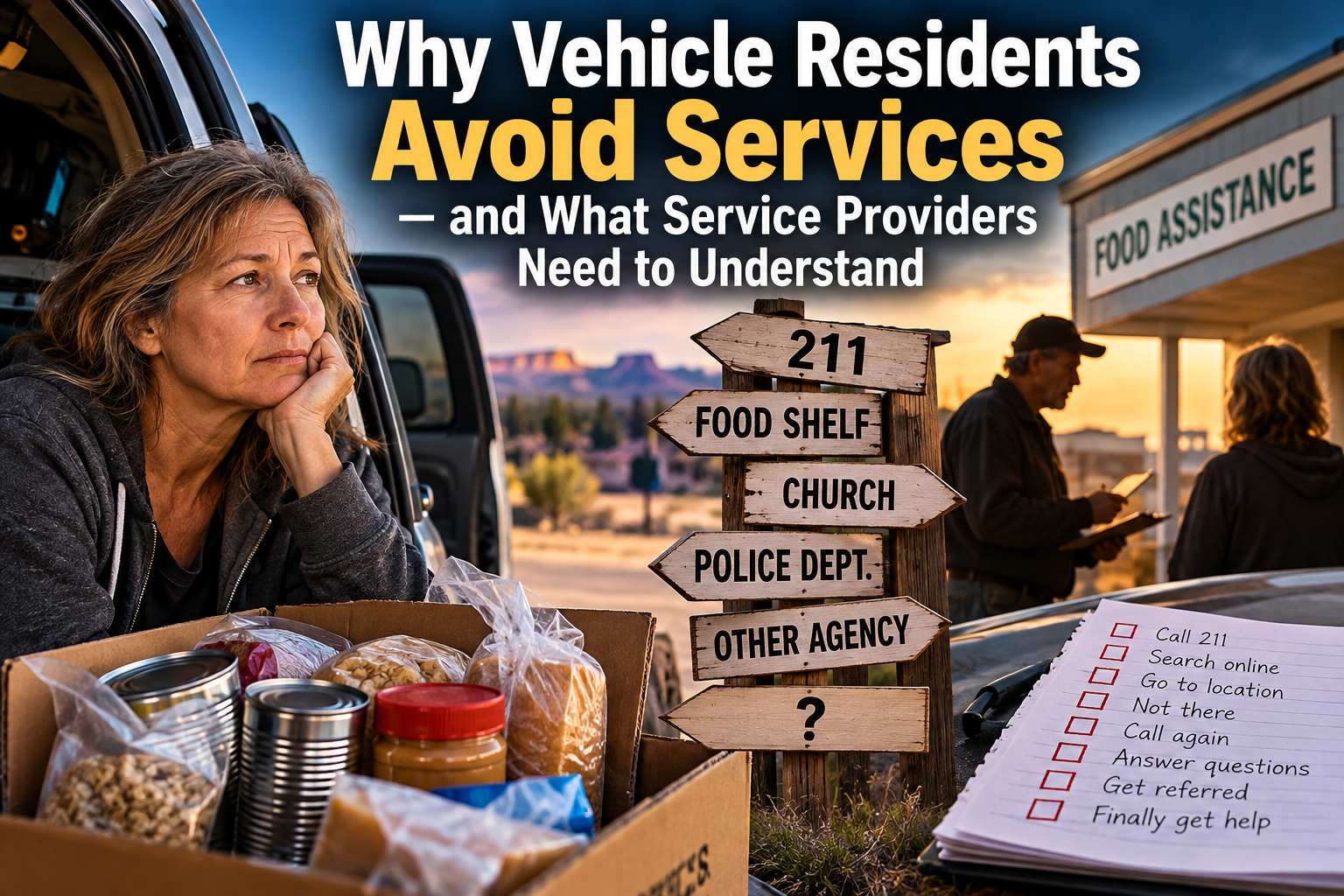
At about 7:30 in the morning, I called 211 because I was looking for food assistance in Williams, Arizona.
The recorded message said they didn’t open until nine.
Okay. I could figure this out myself.
I searched online and found information saying a local church offered a food shelf on Wednesday mornings from 9:00 to 11:00.
So I went there.
There was no food shelf.
I searched again. This time, I found information suggesting that the local police department might be able to help travelers and people in situations like mine find emergency food.
I called.
They didn’t seem to know what to do with me either.
Eventually, they gave me another phone number. I called that number and reached a man who said he could help. We arranged to meet at a location on Route 66.
Finally.
I had found help.
But finding help and feeling helped aren’t necessarily the same thing.
When Asking for Help Changes the Relationship
The man started asking me questions.
Some of them felt personal, and I couldn’t understand what they had to do with whether I needed food.
Eventually, he took me to a food cupboard.
There was food sitting on the shelves, but rather than asking what I could use, he began choosing food for me.
And something happened that surprised me.
I could see other things on the shelves that would work better for my situation. Yet I felt uncomfortable suggesting them.
Why?
I’m 57 years old. I know what I eat. I know what I can store in my vehicle. I know what I can prepare. I know what will get eaten and what will probably go to waste.
But I was the person asking for help.
Somehow, that changed the dynamic.
I felt as though asking for something different might make me seem ungrateful.
And that’s when I started thinking about my friend again.
Maybe We’re Asking the Wrong Question
People sometimes ask why those of us living in vehicles don’t use more services.
Why don’t we go to the food pantry?
Why don’t we contact this agency?
Why don’t we apply for that program?
Why don’t we ask someone for help?
I’ve wondered about it myself.
Vehicle residents can be fiercely independent. Many of us take enormous pride in figuring things out ourselves. We solve problems most people living in conventional housing rarely have to think about.
Where will I sleep tonight?
Where can I fill my water?
How will I keep food cold?
Where can I use a bathroom?
How do I charge everything?
Where can I park without being bothered?
How do I stay warm tonight and cool tomorrow afternoon?
How do I manage all of this when my vehicle is also my transportation?
Self-reliance isn’t just an attitude when you’re living this way. It can become a survival skill.
So maybe the question isn’t simply:
Why don’t vehicle residents want help?
Maybe another question needs to come first:
What happens when we ask for it?
A Referral Isn’t the Same Thing as Access
We talk a lot about connecting people with resources.
Call this number.
Visit this website.
Go to this organization.
Apply for this program.
But my experience that morning showed me how different a resource can look from the other side.
Someone looking at the eventual outcome might say the system worked.
I needed food, and eventually I received food.
But look at everything between those two points.
I called one resource that wasn’t open yet. I followed information that led me to a service that apparently wasn’t there. I contacted another organization that didn’t seem to know where to send me. I received another phone number. I called another person. I arranged another meeting. I answered personal questions. I went somewhere else.
Eventually, I received food.
That’s technically a successful referral.
It didn’t feel particularly successful while I was living it.
Now replace “food” with almost anything else.
Housing assistance.
Healthcare.
Disability services.
Employment assistance.
Veterans services.
Benefits.
Transportation.
Senior services.
Mental health care.
Legal assistance.
The individual organizations may be doing exactly what they’re supposed to do. The problem can appear in the spaces between those organizations.
The left hand doesn’t always seem to know what the right hand is doing.
And the person needing assistance is the one who has to navigate the gaps.
Gratitude and Frustration Can Exist at the Same Time
This is important.
I am grateful that someone helped me get food.
I can appreciate the person who took time out of his day to help me while still talking about the parts of the experience that made me uncomfortable.
Those aren’t contradictions.
And talking about those uncomfortable parts doesn’t mean attacking service providers.
Many service providers are working with limited funding, limited staff, eligibility requirements, reporting requirements, outdated databases, restrictions on what they can provide, and far more people needing assistance than they have resources to serve.
Vehicle residents don’t always see those limitations.
But service providers don’t always see our side either.
That’s exactly why we need to talk to each other.
Help Us Without Taking Over
I keep coming back to one idea:
Help us without taking over.
If you need personal information, explain why you’re asking for it.
If there are choices available, let us make them.
If you’re referring someone to another organization, make every reasonable effort to ensure the information is still accurate.
If someone tells you something won’t work because they’re living in a vehicle, listen to them. They probably understand the limitations of their home better than anyone else does.
And when possible, ask a remarkably simple question:
“What would be most useful to you?”
That question changes the relationship.
It says the person receiving assistance still has something important to contribute to the conversation.
Their own expertise.
Needing Something Doesn’t Make Us Less Capable
This may be the biggest thing I took away from the experience.
Needing help doesn’t mean someone doesn’t know what they’re doing.
Sometimes you’re short on food.
Sometimes you’re short on money.
Sometimes your vehicle breaks down.
Sometimes you need medical care.
Sometimes you need information.
Sometimes something happens that is simply bigger than your ability to solve alone.
That’s being human.
But when asking for assistance means answering questions you don’t understand, being shuffled between organizations, repeatedly explaining your circumstances, or losing control over decisions you normally make for yourself, doing without can start to feel easier.
That doesn’t necessarily mean someone is too proud to accept help.
Sometimes they may be protecting something incredibly important to them:
their independence.
Maybe I Understand My Friend a Little Better Now
I still can’t say exactly why my friend reacted the way she did when I suggested my food shelf video.
That’s her story, not mine.
But after my own experience the following morning, I can understand the feeling a little better.
Maybe what we need isn’t another campaign telling vehicle residents where to find services.
We certainly need accurate information about resources. That’s important.
But perhaps we also need to look at the experience waiting for someone when they actually use those resources.
Because connecting vehicle residents with service providers isn’t really a bridge if we’re only working on one side of it.
Vehicle residents may need to better understand how service organizations work and the limitations they’re operating under.
Service providers may need to better understand why independence, choice, privacy and dignity matter so much to the people they’re trying to serve.
And both sides probably need more opportunities to talk to each other.
That’s one of the conversations I want Road Life Hub to help create.
So I’m asking both sides.
If you’re a vehicle resident: Have you ever avoided a service—or walked away from one—because of the way receiving help made you feel? What would have made the experience different?
If you’re a service provider: What rules, limitations or realities of your work do you wish vehicle residents understood? And what could providers do differently to preserve someone’s independence while still providing assistance?
I don’t pretend to have all the answers about road life.
That’s why your experiences matter here.
Leave a comment and tell me what you’ve experienced, what I’m getting right, what I’m missing, or what you think we should be talking about next.
The bridge can’t be built by one side.
Let’s build bridges, not barriers.
Leave a Reply